
Spotlight Series: Luis Figueroa, Senior Director of Legislative Affairs at Every Texan
Post by Luis Figueroa
LSSC's Spotlight Series profiles just a sampling of our incredible partners in the preemption space. Advocates across the country and across disciplines (from campaigners to communicators, researchers to lawyers) - all have enormous roles to play in protecting local democracy; we hope this series offers inspiration and ideas to anyone who is engaged in fighting abusive preemption in their community.
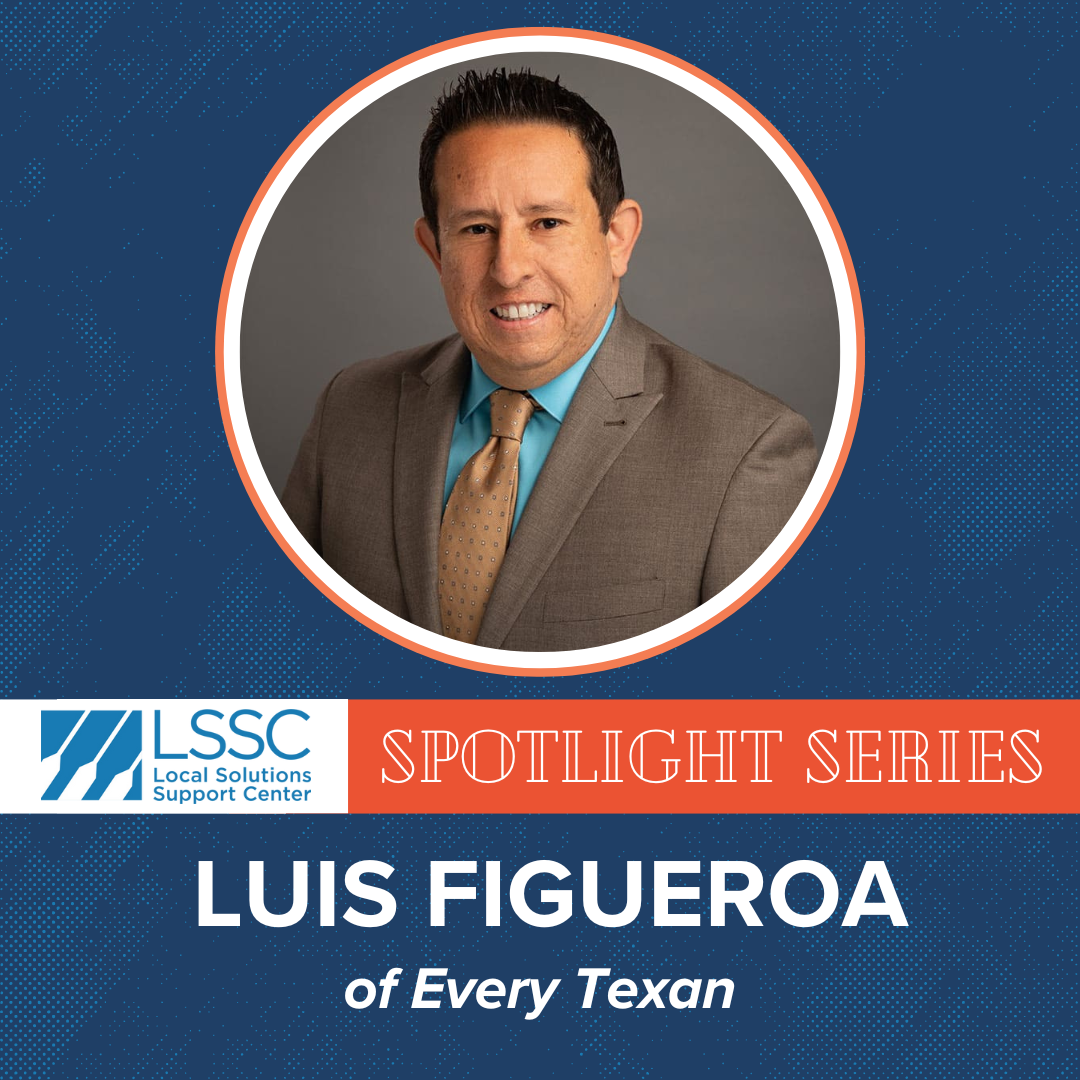
We recently chatted with Luis Figueroa, Senior Director of Legislative Affairs at Every Texan. A proud Texan from El Paso, Luis has a deep knowledge of Texas politics. In his current role, Luis oversees Every Texan’s comprehensive legislative strategy. Before joining Every Texan, Luis was General Counsel for Texas State Senator José Rodríguez and Executive Director of the Texas Senate Hispanic Caucus. Previously, he served as the Legislative Attorney for the Mexican American Legal Defense and Educational Fund (MALDEF), where he worked from 2004 to 2013.
TELL US A BIT ABOUT YOUR JOURNEY AND WHAT BROUGHT YOU INTO THE ADVOCACY SPACE.
I'm originally from El Paso, and my mother is from Chihuahua, Mexico. It was a very mixed status family and so I grew up always thinking about my community and my family. When I finished law school, I got a job working for the Mexican American Legal Defense And Educational Fund (MALDEF), doing civil rights litigation and advocacy on immigrant rights, education and voting rights issues, and had a wonderful career there for nine years. I was really proud of our work, but it was frustrating with the [lack of] resources, and I wanted to see what was going on behind the scenes at the legislature.
I was able to work in the Texas Senate for a couple of progressive senators, including my home city senator, Senator José Rodriguez, and Senator Sylvia Garcia, who's now the first Latina congresswoman from Texas. Later, when [Senator Rodriguez] decided it was time for him to retire, I became the first legislative and policy director of, at the time, the Center for Public Policy Priorities.
We are now called Every Texan, and I've been here since 2018. It's been an incredible journey, leading a team of advocates, getting policy wins on health care, on education, still working on immigrant rights and voting rights and budget and tax policy. Obviously, it's still a lot of defensive work, but we are able to see occasional small wins here and there and really help set the narrative in Texas. Don't get me wrong, it's an uphill battle in Texas every day, but I'm really proud of the work and the team that we have here.
WHEN DID YOU FIRST HEAR ABOUT ABUSIVE PREEMPTION?
I had always heard about preemption in a civil rights context, but more state versus federal – for example, states refusing to desegregate. But when I started working at the Texas legislature, I started hearing more about state level preemption. It was right around this time that the big cities in Texas were becoming more progressive and starting to look towards city leaders for local solutions for policy issues. And the state, which traditionally had been strongly [supportive of] local control, started backing away from that, and we started seeing more and more legislation to prevent cities from doing things. There was a coalition formed while I was still in the legislature called the Coalition Against State Interference, and I was invited to participate in those meetings and see some of the data and trends. That’s when I got familiarized with this idea of abusive preemption.
TEXAS, UNFORTUNATELY, HAS BEEN THE BIRTHPLACE OF A LOT OF REALLY HARMFUL PREEMPTION TRENDS. FROM YOUR VANTAGE POINT, WHICH TRENDS WOULD YOU TRACE SPECIFICALLY BACK TO TEXAS THAT YOU'VE SINCE SEEN SPREAD ELSEWHERE?
The 2023 legislation, known as the Death Star bill, is the one that really put us on the national map in terms of preemption. There was no question that the authors of the bill wanted it to be a model for other states. The frustrating thing about it was, when the proponents would talk about why they wanted this across-the-board preemption policy, they would cite legislation and policies that were already preempted. They'd say, “Oh, we’ve got to get rid of wage increases – we can't afford it. We’ve got to stop the paid sick leave policies.” But both of those had already been preempted under Texas’ minimum wage law. It wasn’t clear what they really wanted to preempt, but it was clear they wanted to send a message to cities and counties that they should tread cautiously in terms of pushing any type of law.
Last year there was a Death Star 2.0 bill where they tried to double down on [the original Death Star bill] and add additional swaths of the government code, and thankfully we were able to defeat it. Hopefully we've started to reverse the [Death Star] trend, but obviously we have a lot of work to do.
WHICH LESSONS DO YOU THINK ADVOCATES IN OTHER STATES CAN LEARN FROM THE WORK OF ADVOCATES AND ORGANIZERS IN TEXAS WHO ARE FIGHTING AGAINST THESE PREEMPTION BILLS?
I think the most impactful response is having a broad spectrum of opposition from not only different walks of life, but different cities and different counties. You can't just walk in there with your blue counties and blue cities. You need to have your red cities. You need to have your communities from across the board, whether it's faith based groups or business communities who are willing to show the economic impacts. These different walks of life can oftentimes persuade just enough to stem the tide on a wide, overly broad preemption bill.
As an example, in the past two legislative sessions there were bills in Texas that would have completely preempted super precincts, or county wide precincts, which allow people to vote at a super center instead of having to go to their individual precinct. It's made voting a lot easier and convenient and reduced a lot of confusion. It's adopted by the vast majority of our counties, and it was started in Lubbock County, the reddest county in Texas.
It was the local officials from Lubbock County that said [to the legislature] “No, we want to keep this program. It’s been a huge benefit to our community. It reduces voter confusion, lowers our costs and makes us more efficient.” And the bill that had passed the Senate in 2023 didn't even get out of committee this year. I think that's a testament to really reaching out beyond our traditional allies and thinking about who benefits from these programs. Oftentimes it's the smaller, more rural communities that benefit from innovation and local solutions.
WHAT ARE THE PREEMPTION-RELATED TRENDS YOU THINK AREN'T GETTING ENOUGH ATTENTION?
Absolutely it's voting rights preemption. In Texas, we've seen bills that would go after county election officials for minor voting discrepancies, which happen in every election – especially in a state the size of Texas, you're going to have the occasional irregularity or malfunction. Those are usually addressed right away. But in Texas, with those irregularities could come criminal charges, redoing elections, recounts, audits, all sorts of ways to put pressure on local election officials. My big concern is that we're going to scare off good long-term county election officials who have been doing this for 30 or 40 years under different administrations, and don’t have a partisan bias, and they’ll get replaced with people who do have an agenda.
We've also seen bills that would change the way counties are able to do voter registration. One bill that was part of that Death Star 2.0 omnibus bill would have preempted the entire election code so that cities and counties couldn’t do anything innovative to try to increase voter registration or voter turnout. And I think that's a real danger. Texas is one of the lowest voter turnout states. It's always been a low propensity voter state and to really hamper innovation and creativity to encourage more voting and more participation, it's just straight up voter suppression, and it's something we've seen throughout history as being a real danger to our democracy and our fundamental democratic institutions and our voting rights.
WHAT'S ONE PARTICULAR WIN IN THIS LINE OF WORK THAT YOU'VE BEEN REALLY PROUD OF?
The one I want to highlight is a program we have in Texas called guaranteed income, or universal income. It’s kind of a misnomer, because it's not a guaranteed income. What it is is, helping people out when someone has gone through a really rough patch – maybe it's a death in the family, or an illness, a job loss. The counties were providing a little bit of income support to these families in some of our cities, including El Paso, Austin, Houston and Dallas. It’s rooted in the idea that some families just need a little helping hand in bad economic times to get them back on their feet.
We were told [the program] was going to get preempted last session and we were just going to have to, at best, mitigate it. And so we organized very early on. With support from an organization called UpTogether, we were able to bring the affected individuals and families to the legislature for an advocacy day, and they got to talk to legislators about their situation. It really brought to light what this program was about. It wasn't about some income/wealth distribution. It was about helping the individual families who have really gone through some tough times.
The bill passed the Senate, and passed out of committee in the House pretty early on, and it was looking pretty dire – but there was an angel somewhere in our calendars committee who held the bill up for about two months, and it never got to the floor of the House. Nobody will necessarily say it on the record, but I know that one of those stories affected a legislator, and they were holding that bill up for us. And you know, those people may not want to go on the record, but we know who those angels are, and it was just something we're really proud of, because it was a community-led fight, and the community itself advocated for it. With our help and expertise and support, we were able to keep that program in place in a very hostile legislative environment.
I'M CURIOUS IF ANYTHING COMES TO MIND IN TERMS OF A LESSON YOU'VE LEARNED DURING YOUR CAREER THAT YOU WOULD SHARE WITH OTHERS WHO ARE DOING COMMUNITY BUILDING AND ADVOCACY WORK.
The thing I would emphasize is bringing those stories. I think those really do make a huge difference, but also where the stories come from matters. A lot of times we focus on our base, or in cities where there is already a lot of support. And so just really going out of your comfort zone and reaching out to local officials in more purple and red areas. A lot of these communities want some flexibility. They want to be able to turn to their local officials and say, hey, we have this issue. What can we do creatively? What can we do locally to fix this?
When you tie their hands, that means that you can only go to the state legislature. I've heard a lot of our conservative legislators saying, I don't want that. I don't want to have to hear from all these local officials that we have to fix their ordinance, or we have to deal with their health and safety codes on a statewide level when this should be a local issue. So I think that message is starting to resonate. But we really have to go beyond our comfort zone and reach out to these communities and local officials that sometimes are not in our direct so-called “base.”
WHEN YOU'RE NOT BUSY IN THIS WORK TRYING TO PROTECT OUR DEMOCRACY FROM PREEMPTION, HOW DO YOU RECHARGE AND TAKE CARE OF YOURSELF?
I have an 11 year old who really reenergizes me. He's just a great kid, and we love to play frisbee together and do sports and talk about life. He created this little bracelet for me that says, "Kill bills today." He is much more informed about the Texas Legislature than any 11 year old should be, but he gets it, and he just really reenergizes me every day. It’s an honor to be able to have someone like that in your life and really think about what this is all about – the next generation.
